Galaxy S27 Ultra may skip the Snapdragon 8 Elite Extreme Gen 6 due to thermal issues
Samsung Galaxy S27 Ultra is likely to be powered by a chipset you might not have thought of.


A man holding the Galaxy S26 Ultra and S Pen. | Image by PhoneArena
Update: Interestingly, Qualcomm does not believe that there is any sort of heating issue in their latest chipset and has called the Seoul Economic Daily report inaccurate. A Qualcomm spokesperson reached out to PhoneArena with the following statement:
Recent reporting about thermal issues related to Snapdragon 8 Elite Extreme Gen 6 is inaccurate. We are proud of the innovation and strong momentum behind our next-generation flagship platform and continue to work closely with global OEMs to deliver premium user experiences.
The original story follows below:
Plenty of exciting information has surfaced about the Galaxy S27 Ultra to date. Its renders, cost, battery capacity, and more have been shared by some really reputable sources. Now the latest leak sheds light on its processor, and, most importantly, it hints that Samsung may break its five-year-long practice regarding the use of a chipset in the Ultra model of the Galaxy S family.
The Samsung Galaxy S27 Ultra could run on the Exynos chipset
That said, there is a possibility that Sammy might consider its own Exynos processor in the upcoming Galaxy S27 Ultra. Most likely, it will be the latest Exynos 2700, which was recently reported to outperform the Qualcomm Snapdragon 8 Elite Gen 6 SoC in several areas, which include CPU, GPU, AI computation, and power efficiency.
Poll
987 Votes
Exynos or Snapdragon: which chipset would you prefer in the S27 Ultra?
Why could Samsung use the Exynos chipset in the S27 Ultra?
A Korean publication, SEDaily, reports that the SoC exceeded its temperature threshold while running resource-demanding tasks on it, ultimately resulting in performance throttling. Samsung has reportedly been testing the chipset for over a month. The performance concerns have already been shared with Qualcomm, and both companies are said to be working on finding a solution to the problem.
If the heating problem is resolved, then Samsung will use the Snapdragon 8 Elite Extreme Gen 6 processor in the Galaxy S27 Ultra. However, if Qualcomm fails to make the needed improvements, the South Korean giant will very likely use its own Exynos 2700 chip in the upcoming Ultra model in order to make sure that its mass production can start by the end of this year. If this unlikely scenario takes place, this could be the first time the Galaxy S Ultra flagship launches with an Exynos chip in all markets.
Snapdragon 8 Elite Extreme Gen 6 has been in the news for wrong reasons
Is Qualcomm having another Snapdragon 810 moment?
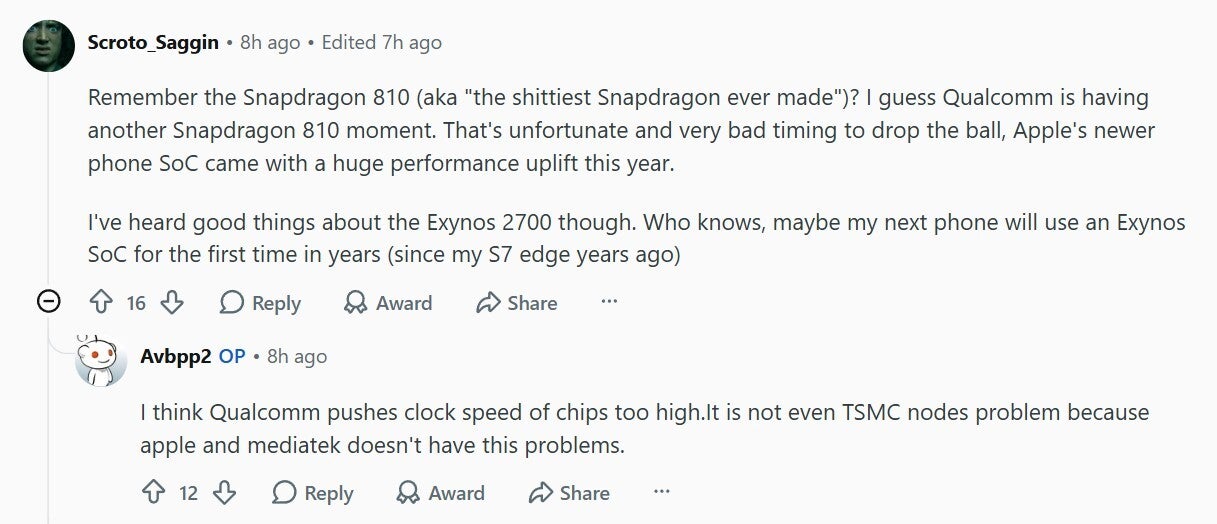
Comment about Snapdragon 810 on Reddit. | Image by Reddit
Some users also believe that the problem might actually be with the TSMC 2 nm node on which the latest Snapdragon chip is built. The same question arose when some devices that were powered by it started randomly restarting in China. There is no official confirmation on this, but I, personally, don't think this is the case, as the latest A20 Pro chip that powers the iPhone 18 Pro is also built on the 2 nm process, and there haven't been any performance concerns on it.
Will the use of Exynos have any effect on the Galaxy S27 Ultra performance?
Also, as mentioned above, the latest Exynos SoC defeats the Qualcomm Snapdragon 8 Elite Gen 6 in some important areas. All this suggests that the performance difference wouldn't be much. But again, the real performance test will only happen when and if we get to test the Exynos-powered Galaxy S27 Ultra.
There's plenty more to read about the S27 Ultra:

Popular stories






Latest News






Things that are NOT allowed:
To help keep our community safe and free from spam, we apply temporary limits to newly created accounts: